Radiant Heating
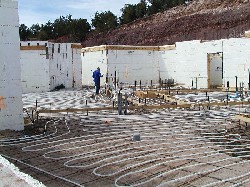
Radiant floor heating is the best solar heating opportunity. This is for two reasons. Radiant floor heating works well with fluid temperatures lower than other hydronic heating systems (100-140 degrees F in most cases.) Since solar collectors operate efficiently in this temperature range, solar heated fluid can be fed directly into a radiant floor. As in many cases radiant floor tubing is installed in thermal mass such as concrete, brick, or stone, the floor itself can be used for solar heat storage (Cedar Mountain Solar has developed control systems that carefully regulate such storage.) Heat distribution systems that do not include thermal mass require other means of solar heat storage.
Baseboards typically work best at higher temperatures, often 160-180 degrees F. In baseboard heating systems, solar collectors are used to pre-heat a boiler. This approach reduces the fuel consumption of the boiler, as it is only required to make up the difference between collector temperature and ideal temperature.
Water tanks are also used in some solar heating systems to provide thermal mass if the building construction lacks it. A well-insulated 2,000 square foot heated area without mass floors, located in northern New Mexico, would typically require 300-400 gallons of water storage. This can consist of several smaller tanks plumbed together, or large un-pressurized tanks that are assembled on site.
Radiant Floor Heating
Radiant Floor (also known as warm floor heating) is most compatible with the use of flat-plate solar collectors due to the design temperatures. A major factor in considering solar radiant heating is the architect or homeowner’s decision to use mass floors, such as cement, stone, or brick rather than non-mass floors such as wood.
Solar-Direct Injection
Solar-direct injection is the simplest solar-heated radiant floor design. It consists of a closed loop between the heating tubes in the floor and the collectors. The solar heated liquid flows directly from the solar collectors into the tubes in the floor, warming the building. This approach works well with a well-insulated mass floor in a sunny climate, and for some snow-melt systems. Such a system does not include back-up radiant floor heating, though a wood stove, wall furnace, or other backup heat source can be used. A tempering valve is used to regulate fluid temperature in the floor, mixing supply and return fluids together as needed. This system does not use a storage tank, but relies only on the mass of the floor to radiate heat through the night.
Primary-Loop Injection and Distribution
This is most common type of solar heating system supplied by Cedar Mountain Solar. It allows for controlled incorporation of multiple heating sources, including solar, boiler, geothermal heat pump, etc. with multiple heating loads including warm floors or baseboards, pools and spas, and domestic hot water.
In a primary loop system, a manifold consisting of copper pipe, check valves, and isolation valves is installed, typically on the ceiling of the mechanical room. The manifold has inputs and outputs connected to heat sources and heating loads. The solar collectors feed heat into this loop, as does the boiler or any other heat maker. Similarly, the different heating loads draw heat from this loop. These can include warm floors, baseboards, domestic hot water, pools and spas, and water storage tanks. The system is controlled to prioritize the use of solar heat when available, and can also be controlled to prioritize some heating loads over others and to shed excess heat as needed.
There are several advantages to installing primary-loop systems. The loop provides an obvious place for central attachment of all control sensors. This piping method also allows each heat source and heat load to operate at its ideal flow and temperature, promoting component efficiency and longevity. Such a system is also very modular – additional heating sources and heating loads can be added easily in the future. A primary loop basically provides the system designer and installer a means of organizing the system for greatest effectiveness.
|